Module · Customers
Where to find it in the app
- Use it: Customers → Customer list
- Turn it on/off: your business name (top-left) → Settings → Modules → Customers → Customers
Plan: Solo and Business · Module group: Bookings & schedule · Navigation:
Customers → Customer list
1. Overview
Purpose. A single record for everyone who has booked or been invoiced, their history, total spend, your private notes and tags, and their marketing consent. It's the CRM for salons, clinics, studios, trades and any relationship-based business.
How it's built. HappierBiz derives the directory automatically from your bookings and invoices, grouping by the person's email so the same customer isn't duplicated. You then enrich each record with notes, tags and consent. You can also add a customer manually (7d), handy for wholesale/corporate contacts or people you want on file before their first booking.
2. When to use it
- To look up a returning customer's history before they arrive.
- To keep private notes (preferences, allergies, account details) against a person.
- To record and manage marketing consent lawfully (see §7c).
3. Required permissions
- View customers (
customers.view), see the directory and records. - Add / edit customers (
customers.manage), edit notes, tags, consent, archive/restore/delete.
4. Navigation path
Customers → Customer list
5. What you'll see
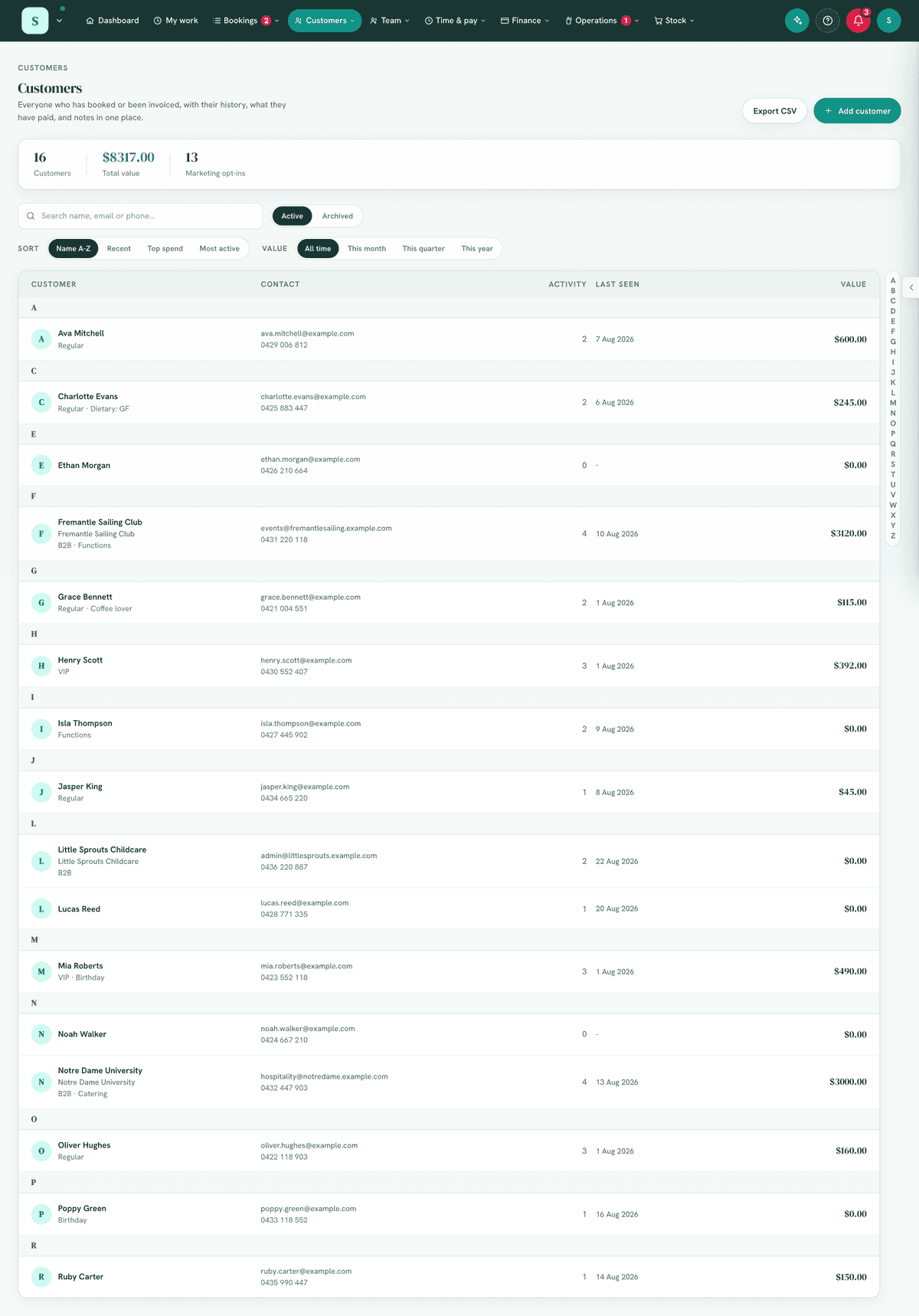
- A stats band: number of customers, total spend, marketing opt-ins, and archived count.
- A search box (name, email or phone) and an A-Z letter filter, with Load more paging for large lists.
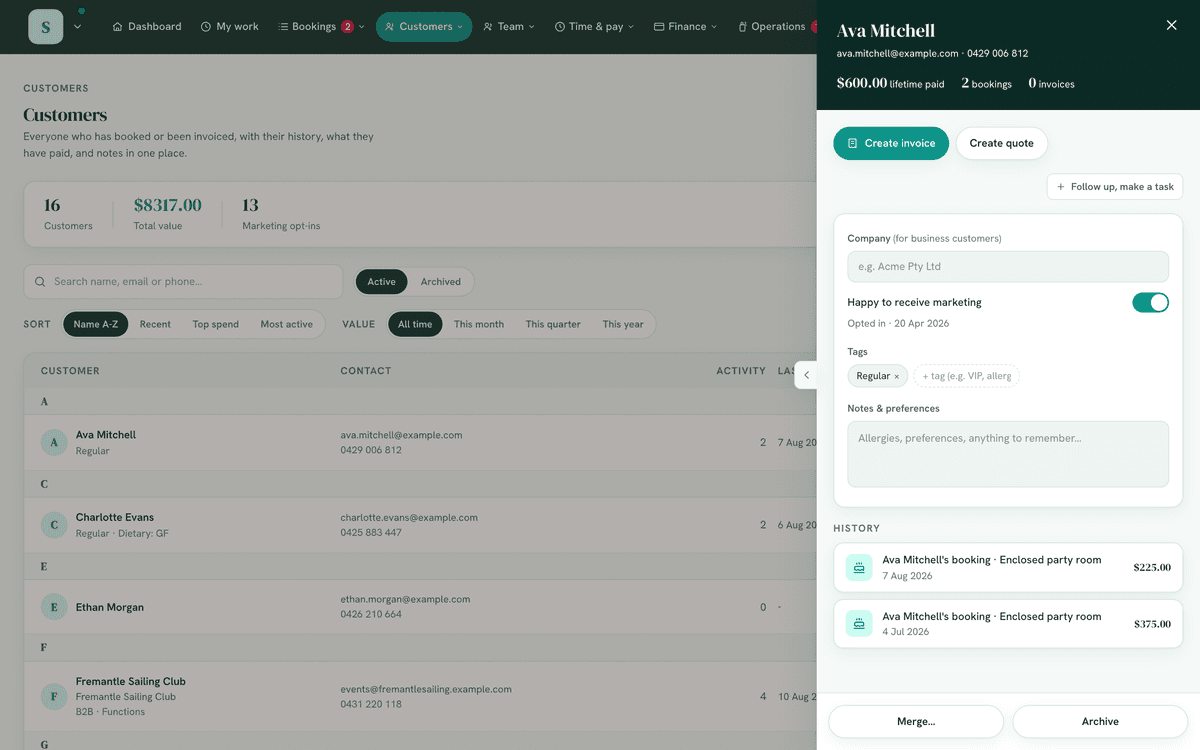
- A list of customers; selecting one opens a drawer with their booking & invoice history, spend, visit count, last seen, company (for B2B customers), notes, tags and a marketing consent control showing how/when consent was given. From the drawer you can also start an invoice or quote for that customer.
- An Add customer button (see 7d).
6. Turning it on
Settings → Modules → Bookings & schedule → Customers. Records appear as
soon as you have bookings or invoices.
7. Step-by-step tasks
7a. Find a customer
- Open
Customers → Customer list. - Type a name, email or phone, or tap a letter.
- Select the customer to open their record.
7b. Add notes & tags
- Open the customer.
- Type notes (private to your team) and add tags (e.g. VIP, Sensitive skin).
- Changes save against their profile, they never overwrite the booking/invoice history that feeds the record.
7c. Record marketing consent (compliance)
HappierBiz follows Australian Spam Act practice: consent is never pre-ticked or assumed.
- Open the customer.
- Toggle marketing consent on only when the person has genuinely agreed.
- When you turn it on, the system records when and how (here, "Recorded manually"). The record also shows other bases, Opted in at booking, Imported, and the date.
- Turning consent off records an opt-out date. Customers can also unsubscribe themselves; that updates this automatically.
Only people with consent receive marketing, see Marketing.
7d. Add a customer manually
- Choose Add customer.
- Enter their name and email (plus phone, company, tags and notes as needed). Only tick marketing consent if they've genuinely agreed, it's recorded as "Recorded manually" with the date.
- Save. The record behaves like any other; their bookings and invoices attach to it by email from then on.
7e. Merge duplicate customers
A person who booked under two different emails appears as two records.
- Open the record you want to keep.
- Choose Merge, then pick the duplicate to fold into this one.
- Confirm. Their notes, tags, consent and history roll up to the kept record.
7f. Archive, restore or delete
- Open the customer.
- Archive to hide someone you no longer deal with (reversible, Restore brings them back).
- Delete removes their notes, tags and consent and stops them reappearing in the directory. Their booking and invoice history is deliberately kept as a business record. You'll be asked to confirm.
8. Examples
- Beginner (salon): before a client arrives, search their name, open the record and read your note "prefers low lights, allergic to PPD."
- Real-world (clinic): tag patients by service type and use spend/visit history to see your most loyal clients.
- Advanced (studio): record manual marketing opt-ins captured at the front desk, then use Marketing to email only the opted-in segment, confident every recipient consented.
8b. Messages, and when a conversation closes
Customers → Messages is the two-way inbox for the threads your customers start about their own bookings. Two boundaries are worth knowing about.
Only a customer can start a thread. There is no "message this customer" button anywhere in HappierBiz, by design. You reply to people who wrote to you; you cannot open a conversation with somebody who did not. To reach customers who have not written, use Marketing.
Your side of a thread closes after a while. By default, 30 days after the booking. Once it closes the reply box is replaced by a short note saying so, and the thread stays completely readable. Nothing is deleted.
- Their side never closes. A customer can always write to you.
- Anything they write reopens it, straight away, for another full window.
- Change it with My replies close at the top of Messages. Options run from 14 days to 90, or Never closes if you would rather threads stayed open indefinitely. Managers only.
Why it exists. A reply about a booking is a normal, factual message. An offer or a piece of news is marketing, and Australian law treats the two differently: marketing needs the customer's consent and an unsubscribe link on every message. The Marketing module does both automatically. A booking thread does neither, so sending offers through one is the part that can get a business into trouble. The closing window keeps the two apart without stopping you answering anyone.
If you send the same message to three or more customers in a day, Messages says so and points you at Marketing. It never blocks the message.
Your customers can switch the emails off. Every "you have a new message" email carries a link letting them stop those emails, either for that booking or from your business altogether, and the same tick box sits under the chat on their booking page. When somebody has switched them off you will see a note at the top of their thread. Your replies are still saved and they still see them next time they open their booking, they just are not emailed about it. Emails about the booking itself, confirmations, changes and receipts, are never affected.
9. Reports & exports
The stats band gives live totals (customers, spend, opt-ins, archived). Spend and visit history per customer are shown in the drawer. The Export CSV button (top right) downloads whichever directory view you're on, active or archived, as a spreadsheet-ready file with each customer's contact details, visits, spend, consent and notes. Marketing audiences are built from consent in the Marketing module.
10. Common mistakes
- Re-typing customers who already exist, most records appear automatically from bookings/invoices; use Add customer only for people with no booking yet, and search first.
- Duplicate-looking customers, records group by email; a person who booked under two different emails appears twice. Merge them (7e), and standardise on one email going forward.
- Turning on consent to "be safe", don't. Only enable it when the person actually agreed; the record is an audit trail.
- Deleting to "tidy up" and expecting history to vanish, history is kept on purpose; use Archive for tidying.
11. Troubleshooting
| Problem | Fix |
|---|---|
| A new booking's customer isn't showing | The directory groups by email, a booking without an email won't form a CRM record. Add the email to the booking. |
| Two records for one person | They used two different emails. Use Merge (7e) to fold them into one, and standardise on one email going forward. |
| Marketing won't send to someone | They have no recorded consent, or they unsubscribed, check the consent control. Also check the "customers aren't receiving your emails" panel: a bounced or complained address is held back regardless of consent. |
| "N customers aren't receiving your emails" | Their address bounced (usually a typo) or they reported an email as spam. Fix the address on their record, then press Try this address again. Until then nothing is sent to a bounced address, and marketing is withheld from one that reported spam (receipts and booking confirmations still go out to those). |
| A deleted customer reappears | A new booking/invoice under the same email recreates the record (history-derived). |
12. Error messages
Customer edits save inline (e.g. "Customer deleted", "Customer archived"). The delete action shows a confirmation dialog spelling out that notes/tags are removed but booking & invoice history is kept.
Related: Marketing · Bookings · Invoicing · Marketing consent stance (compliance)