
Module · Shopping list
Where to find it in the app
- Use it: Stock → Shopping
- Turn it on/off: your business name (top-left) → Settings → Modules → Stock → Shopping list
Plan: Solo & Business · Module group: Stock · Navigation:
Stock → Shopping
1. Overview
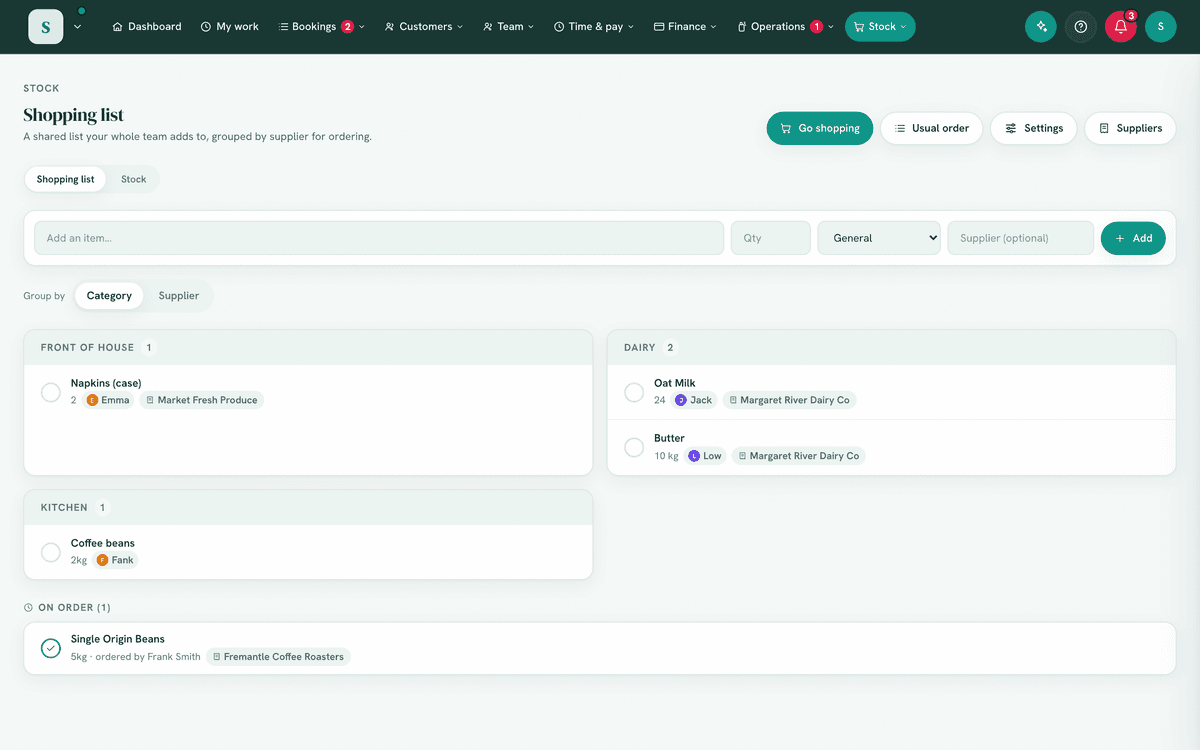
Purpose. A shared, synced ordering list that replaces the back-of-house whiteboard. Anyone can add what's needed, group by category and supplier, and tick items off as they're ordered and received. It can also track stock levels and suggest low items to add, and holds a suppliers directory.
2. When to use it
- For day-to-day "we're out of…" ordering.
- To keep supplier contact and account details handy.
- To turn low stock into an order list.
3. Required permissions
- View shopping list (
shopping.view). - Add / edit shopping items (
shopping.manage).
Staff permissions. Managers can set exactly what staff with view access may do here, open the list's settings and toggle Add items, Tick items off, Remove & clear items, Receive into stock and Edit the supplier book to suit your business. Managers can always do everything.
4. Navigation path
Stock → Shopping
5. What you'll see
- The list of items, each with quantity, category and optional supplier, and a status (needed → ordered → got).
- An Add item field (with qty, category, supplier).
- A prompt to Add N low items to the list when stock tracking flags items below their level.
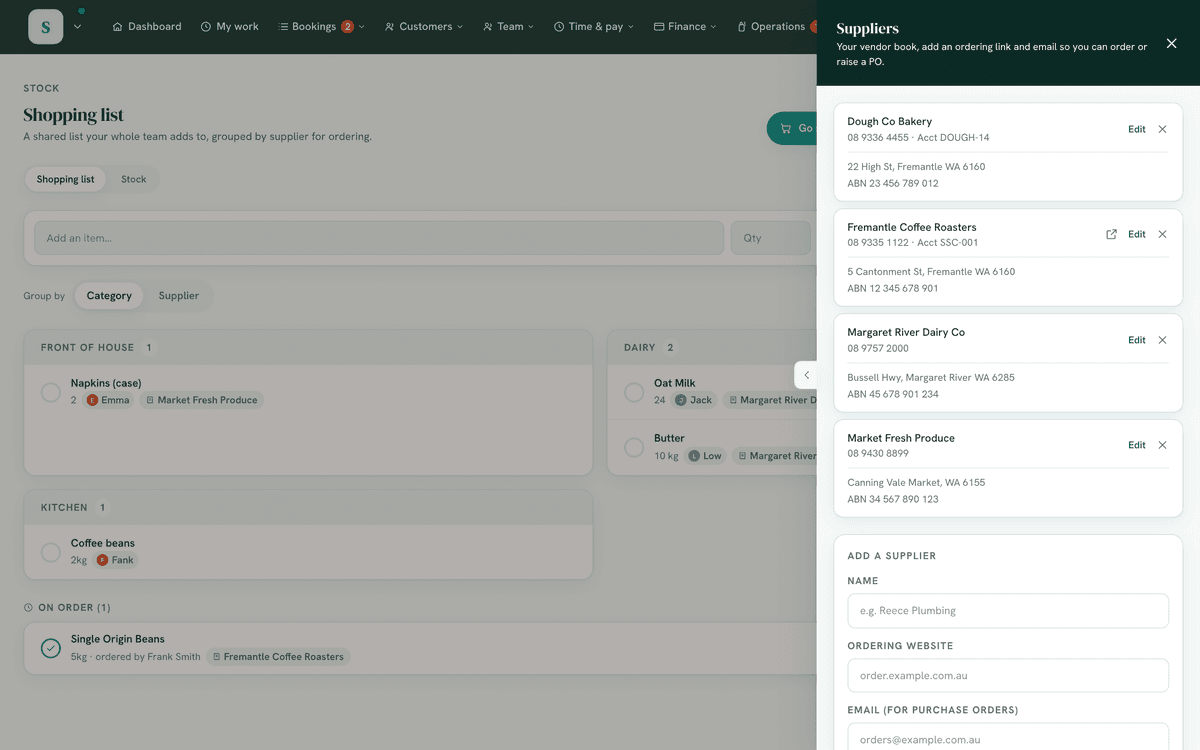
- A Suppliers directory (name, website, phone, email, ABN, address, account reference, notes).
- Go shopping, a full-screen, phone-first version of the list for the aisles: big rows you tap to tick, live progress, and a Print button for a paper checklist.
6. Turning it on
Switch it on in Settings, the Modules tab, under Stock (available on both plans). If you chose a relevant business type at sign-up, you'll start with a few example items.
7. Step-by-step tasks
7a. Add and order items
- Type an item in Add item, with a quantity, category and (optionally) supplier. Tap the Supplier box and your suppliers drop down: pick one, type a few letters to narrow the list, type a name nobody has used before, or leave it empty. A brand new name also offers Add to your supplier book, so next time it is in the list and can hold their website, phone, ABN and account reference. Then add it. Adding something that's already on the list folds into the one line, summing the quantity when the units match ("1kg" then "2kg" becomes "3kg") and joining them as text when they don't ("1 bag + 2kg").
- As you place the order, mark items ordered; when they arrive, mark them got. The list stays in sync for everyone.
7b. Add low stock to the list
- When stock tracking flags items below their level, choose Add N to list.
- They drop into the shopping list ready to order. With Add low stock to the list for me switched on (the default, in the list's settings), this also happens automatically the moment an item drops to its reorder level.
- Typing an item by hand whose name matches a stock item links the two, so it can be received into stock once bought.
7b-ii. Receive bought items into stock
- When a stock-linked item is marked got, a Receive to stock button appears on it.
- One tap adds the quantity to the item's on-hand count and takes it off the list. Managers can always do this; staff can when Receive into stock is switched on in the list's settings.
7b-iii. Stock items: archive & restore
Archiving a stock item hides it (keeping its full movement history); Show archived items at the bottom of the Stock page lists them with a Restore button. Each movement in an item's history shows who recorded it.
7c. Go shopping (at the shops)
- Tap Go shopping for a full-screen list built for one hand in a shop: big rows, tap anywhere on a row to drop it in the trolley, tap it again to put it back.
- If the list has more than one supplier, it asks where you are going first. Pick a shop and you get only their items, grouped by category. The trolley, the progress bar and the printed sheet all follow that choice, so nothing on screen is about a shop you are not standing in. Choose Everything for the whole list, still kept apart by supplier.
- Finish a shop and it says so, with a one-tap button through to whatever is still to get at each of the others. Tap the supplier name at the top any time to switch.
- Print gives you a pen-and-paper checklist of whatever the screen is showing, headed with the supplier it is for.
- Two people can shop together: the list refreshes every few seconds, so you each see the other's ticks.
- On a phone, use Add to home screen and it opens full-screen straight into this view.
7d. Manage suppliers
- Open Suppliers.
- Add a supplier with their website, phone, email, ABN, address, account reference and ordering notes (e.g. "Order by 2pm for next-day").
- Assign items to a supplier so the list groups by where to order, and so Go shopping can offer one trip per shop.
8. Examples
- Beginner (café): add Full cream milk · 6×2L · Kitchen and tick it off once ordered.
- Real-world (restaurant): group the list by supplier so each order is one glance; store Bidfood with the account ref and cut-off time.
- Advanced: use stock levels so the system surfaces low items and you bulk-add them to the next order.
9. Reports & exports
The live list (grouped by category/supplier) and the suppliers directory are the record. Items to order also show as the dashboard Shopping to order shortcut.
10. Common mistakes
- No supplier on items, then the list can't group by where to order, and Go shopping has no shops to offer you.
- The same supplier spelled two ways, then one order looks like two. Pick them from the Supplier box rather than retyping the name.
- Not marking items got, the list grows stale; tick them off on arrival.
- Duplicate items, search the list before adding.
11. Troubleshooting
| Problem | Fix |
|---|---|
| Low-stock suggestions don't appear | Set stock levels on items so the system knows what "low" is. |
| The dashboard shortcut count looks wrong | It counts items still needed; mark ordered/got to clear them. |
| Can't add or edit | You need Add / edit shopping items, or, for staff with view access, a manager has that staff permission switched off in the list's settings. |
12. Error messages
Adds and status changes confirm inline. The list syncs across devices, so another staff member's change may appear as you work, refresh if needed.
Related: Recipes & menu