
Module · Payments
Where to find it in the app
- Use it: Finance → Money owed
- Turn it on/off: your business name (top-left) → Settings → Modules → Finance → Money owed
Plan: Solo and Business · Module group: Finance · Navigation:
Finance → Money owed
1. Overview
Purpose. Take deposits and balances online through your own Stripe account, so payouts go straight to your bank. You can charge a saved card for an outstanding balance, or record a manual (cash/eftpos) payment.
Your money, your account. Your money goes straight to your own Stripe account, HappierBiz takes no platform fee (0%) and never holds your funds. Payouts go directly to your bank on Stripe's schedule.
2. When to use it
- To collect a deposit when a customer books online.
- To charge or settle the remaining balance.
- To see what's outstanding and what's been collected.
3. Required permissions
- View payments (
payments.view). - Take / charge payments (
payments.charge).
4. Navigation path
Finance → Money owed
5. What you'll see
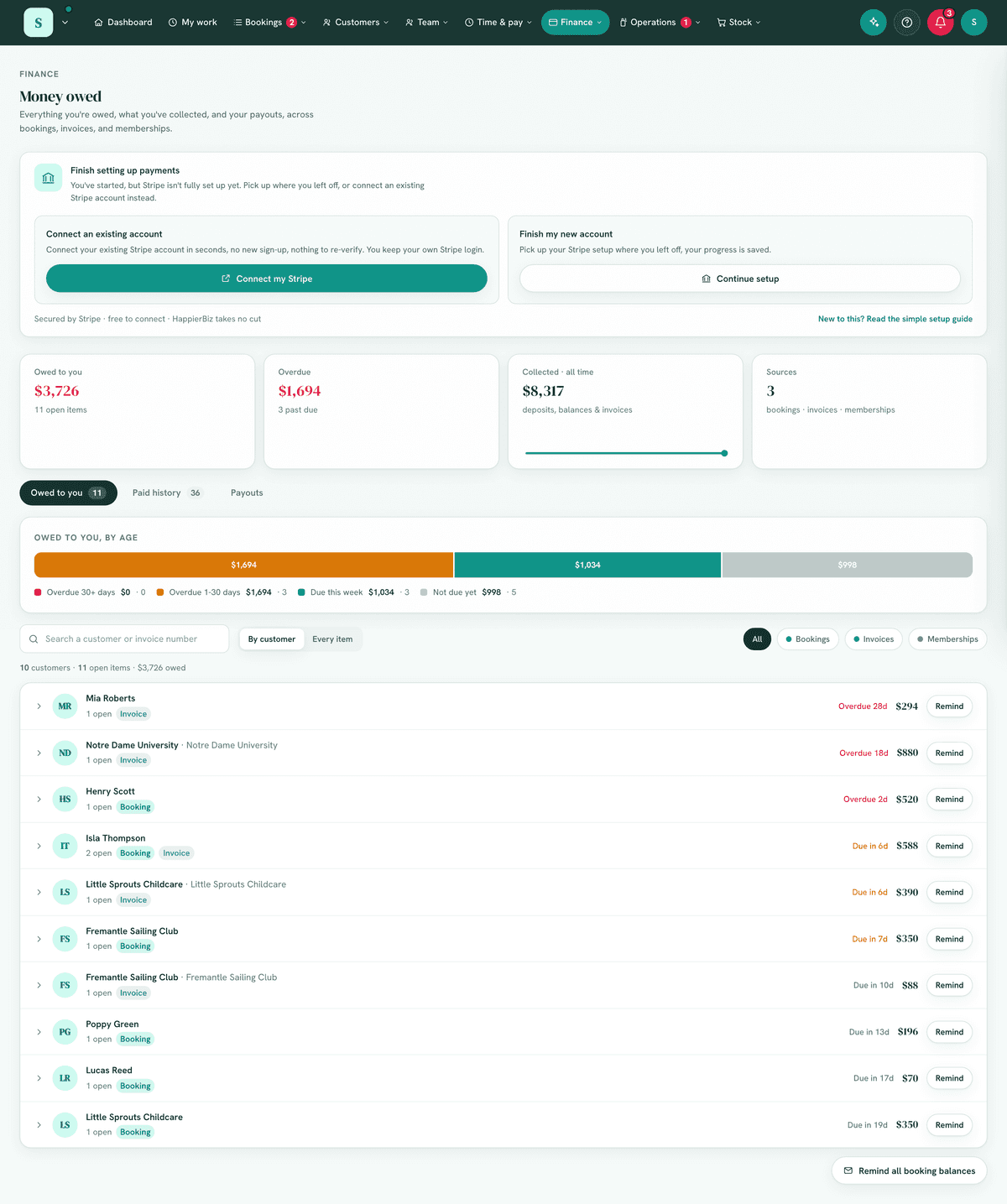
The screen is the Money hub. If Stripe isn't connected yet, a Connect card sits at the top to link your Stripe account ("Payouts go straight to your bank").
Summary tiles run across the top:
- Owed to you: the total still owing, with a count of open items.
- Overdue: how much of that is past due.
- Collected · all time: everything you've taken, sub-labelled "deposits, balances & invoices", with a small trend line once there's enough history.
- Sources: how many of your money sources (bookings, invoices, memberships) are switched on and feeding the list.
Below the tiles are three tabs:
- Owed to you: one unified receivables list that merges booking balances, unpaid invoices and past-due memberships into a single view. Items are grouped by customer (or flip to Every item) and bucketed by age, with an aging bar you can click to filter to a bucket. You can search, and filter by source when more than one is on. Each row's action fits its source: a Charge button for a booking balance with a card on file (or Mark paid when there's no saved card), a Copy pay link for an invoice, and Send portal for a past-due membership so the member can update their card.
- Paid history: deposits and balance payments collected.
- Payouts: money paid out to your bank.
6. Turning it on & connecting Stripe
Settings → Modules → Getting paid → Payments.Open
Finance → Money owed. The connect card asks one question first: do you already use Stripe?- I already use Stripe, sign in to Stripe and link your existing account in seconds. There's no new sign-up and nothing to re-verify: you keep your own Stripe login, dashboard and settings.
- I don't have Stripe yet, a guided new-account setup (about 5 minutes). Stripe walks you through your ABN, bank account and photo ID on its own pages.
Security note: enter banking and identity details directly on Stripe's own secure pages, never share them in chat or by email. When Stripe says charges are enabled, you're ready to take payments.
Back in HappierBiz, the Connect card is replaced by your live payments view.
Notes on linking an existing account.
- The I already use Stripe option only appears when the platform has account linking enabled, otherwise you'll simply see the new-account setup.
- A Stripe account that's managed by another platform (for example a Stripe account Shopify created for you) can't be linked. The app tells you if this happens and offers the new-account path instead.
- Picking the wrong option isn't a trap: until payments are fully live, both paths stay available, and a half-finished setup resumes where you left off.
New to this? There's a plain-English, printable setup guide on the Connect card (and in Help → User manual → Setup guides):
Finance → Payments → Setup guide (PDF). It walks an absolute beginner through connecting Stripe step by step, and the Download as PDF / Print button saves it as a PDF.
7. Step-by-step tasks
7a. Take a deposit at booking
Deposits are collected automatically when a customer books an experience that requires one (set on the experience, see Bookings). They appear under Paid history and reduce the outstanding balance.
7b. Charge an outstanding balance to a saved card
- On the Owed to you tab, find the booking. The Charge button only appears when the customer has a card on file, saved when they paid their deposit online. Rows without one say no saved card.
- Choose Charge, HappierBiz charges the saved card via your Stripe for the exact amount owing.
- On success you'll see a confirmation (e.g. "Charged $X to
's card" ).
If there's no saved card, take payment another way (cash, eftpos, bank transfer) and use Mark as paid instead (7c).
7c. Record a manual payment
- For a cash/eftpos payment taken in person, choose Mark as paid.
- Pick how they paid from the list. It is the same list on a booking and on an invoice, and the words you choose are printed on the customer's receipt.
- The balance is cleared without a Stripe charge.
The list is yours. Settings → Payments → How your customers pay you in person
starts with Cash, EFTPOS, Bank transfer and Card, and you can rename them, remove the
ones you never take, or add your own (Voucher, Account, "Tap at the door"). Remove them
all and the standard four come back, so you can never end up with an empty list.
Changing it affects the next payment your team records. Anything already recorded keeps the words it was given, so a receipt your customer is holding still reads the same.
7d. The tax invoice your customer gets, automatically
You do not raise anything. The moment money arrives, the customer is emailed a document. If you are registered for GST and your ABN is saved, it is a valid tax invoice and says so; otherwise it is a plain receipt, because only a GST-registered business may issue a document titled tax invoice.
It happens on every payment: a deposit, a balance, a card charged automatically, a cash or EFTPOS payment you key in, an invoice paid online or settled in cash, a cancellation fee, and membership dues. What the customer gets does not depend on how they paid you.
Money against an invoice is receipted to the customer but is not filed again in the Receipts tab, on purpose. The invoice is already your numbered document and it lists its own payments, so a second one for the same money would be paperwork twice. The Receipts tab holds money that has no invoice behind it: bookings, memberships and cancellation fees.
It is itemised. Not "Deposit paid $110.00", but what they actually bought:
Party package, Weekend High Tea     1 × $350.00
Chips Platter                       1 × $33.00
Party Bags (per guest)              8 × $7.70
                        Total (inc GST)   $486.00
                        Less already paid  -$110.00
                        Amount due         $376.00
Per-guest extras are multiplied out by the headcount, and a GST-free line is marked as one so the totals split taxable from GST-free. It is the same document your invoices use, which is why a customer who gets both sees one description of what they bought.
What is on it, which is everything the ATO asks a tax invoice to show:
| Date | the day the money arrived, not the day you typed it in |
| For | what they bought, in your words, with the date of the booking |
| Reference | your booking reference, so they can quote it |
| Received from | who paid |
| Amount paid | with Includes GST, or "None, this is a GST-free sale" |
| How it was paid | Cash, EFTPOS, Bank transfer, Card |
| Still to pay | when a balance remains |
| ABN | yours, checked against the ATO check digit |
Two things worth knowing:
- Back-dating carries through to the customer's copy. Cash taken on Friday and recorded on Monday produces a document dated Friday, which is the day it belongs to for both of you.
- A payment of $1,000 or more must also name the buyer. It does, from the booking. If a booking somehow has no contact name, the document stays a plain receipt rather than an invalid tax invoice.
No ABN saved? Then none of your receipts can be tax invoices, and your business customers cannot claim the GST back through them. Worse, where no ABN is quoted a business customer may be required to withhold 47% of the payment. Add it in
Settings → Invoice & tax details.
Wanting it as a PDF attachment? The email itself is the tax invoice, complete, and that is deliberate: mail filters strip attachments, and a stripped attachment would mean no tax invoice at all. Any email client can save or print this one to PDF.
Whether your deposit is a part payment or a security deposit changes when GST falls due on it. The app treats it as a part payment, which is right for a deposit that comes off the final bill. If yours is genuinely held as security, ask whoever does your BAS.
7e. Finding a receipt again, and sending another copy
Every receipt the app emails is kept, numbered REC-0001 upwards, under
Finance → Invoicing → Receipts. The tab appears as soon as you have one.
You can:
- Read it exactly as your customer got it. View or print this receipt opens the document itself, and your browser's Print can save it as a PDF.
- Send it again. "Can you resend my receipt?" now has an answer. It asks which address to use, prefilled with the one on file, so you can send it to a different one when they ask. Nothing is charged, it is an email.
- See whether it arrived. A receipt that bounced is marked Not delivered with what the mail provider said, so you can correct the address and send again.
- Copy the link for the customer. Paste it into a text message when somebody would rather have it that way than by email.
7f. Your customer's own copy
A receipt is your customer's tax invoice for what they bought, and they may need it years later: at BAS time, when their bookkeeper asks, or when their accountant is going through the year. So every receipt email carries a private link to it.
They open the link and press Print or save as PDF, and their browser makes the
file. There is no attachment for a mail filter to strip, nothing to expire, and it is
the same document you sent them, rebuilt from your own record of it. It shows what
they bought, what they paid, the GST, your ABN and its REC number.
It cannot do anything. There is no payment on it, no form, no button that changes anything. It only shows the document.
The link is private, not public. It is a long random address that is never listed anywhere and never appears in a search engine. Anybody who has it can see that one receipt, which is the same as anybody who has the email they were sent.
Turning it off. At the top of the Receipts tab, untick Let customers print their own receipt. While it is off, no receipt link opens, including any already sent, and new receipt emails go out without one. Only an owner or a manager can change it.
Took payments before this existed? There's a card on the Receipts tab, File receipts for past payments, and it tells you how many payments are waiting. It adds your own copy of the receipts the app has already emailed, so you can find them here. Once there's nothing left to file, the card goes away, so it is asking a question rather than sitting there for ever.
⚠️ Nothing is emailed to your customers. They were sent their receipt on the day they paid; sending it again months later would read as a second charge. This only fills in your side. Pressing it twice is safe, and it says what it filed and what it left out.
It leaves out anything that isn't money you actually kept: payments that never completed, ones you refunded in full, cancelled bookings, and membership payments (there's no booking to itemise from). Backfilled receipts show as On file rather than Sent, because the app is holding your copy without a record of that particular send.
Receipts cannot be edited, deleted or voided. They are your record of money you have actually taken, so they stay exactly as they went out. If something about a payment was wrong, fix the payment (refund it, or record the right one); the receipt for what happened stands.
They are not invoices, and they are not counted as income twice. A receipt does not appear in Outstanding, in your GST reports, in the aging list, in the invoice chase or in the Xero push. Your income is counted once, from the payment itself. The Receipts tab shows one figure, Received, which is what actually landed.
⚠️ A part payment's receipt describes the whole booking. A $110 deposit on a $486 party produces a document for the $486 supply showing $110 received and $376 still to pay, which is an ordinary tax invoice with a part payment on it. The list shows the $110 that hit your bank, because that is the number you are usually looking for.
8. Examples
- Beginner (venue): a party deposit is taken when the customer books; on the day you Mark as paid the balance they settle in cash.
- Real-world (clinic): charge the outstanding balance to the card on file after the appointment.
- Advanced (multi-service): monitor Owed to you daily, auto-charge cards for balances due, and reconcile Payouts against your bank.
9. Reports & exports
The Paid history and Payouts tabs, plus the Owed to you and Collected summary tiles, give a live financial picture. For accounting, raise invoices and use the Accounting export. (Payments tracks card collections; invoices track billed income, they can legitimately differ.)
10. Common mistakes
- Trying to take payments before connecting Stripe, connect first; charges must be enabled on your Stripe account.
- Confusing Payments with Invoicing, Payments handles card collection; Invoicing produces the billing documents that feed accounting.
- Raising an invoice just to give the customer a tax invoice. They already have one, emailed the moment they paid. Raise an invoice when you want a single document for a whole job, or to bill on account, not to produce a receipt.
- Charging a card the customer didn't save, auto-charge needs a saved card; otherwise mark paid manually.
11. Troubleshooting
| Problem | Fix |
|---|---|
| Can't take any payments | Stripe isn't connected or charges aren't enabled, finish Stripe onboarding. |
| A balance won't auto-charge | There's no saved card for that booking, take payment another way and mark paid. |
| Payout hasn't arrived | Payouts follow Stripe's schedule to your bank; check the Payouts tab and your Stripe dashboard. |
| A payment was disputed (chargeback) | The payment is flagged in-app and the owner is emailed. In-app refunds are blocked for a disputed payment, the money is already held for the dispute, so respond to the dispute in your Stripe dashboard before the deadline. |
| Can't charge/mark paid | You need Take / charge payments. |
12. Error messages
Charging shows a success toast or a short error from Stripe (e.g. card declined) , act on the message. Connection status is reflected by whether the Connect card or the live tabs are shown.
Related: Invoicing · Accounting export · Bookings